
How Parts Relate to Self
The Role of the Self in the Internal Family System

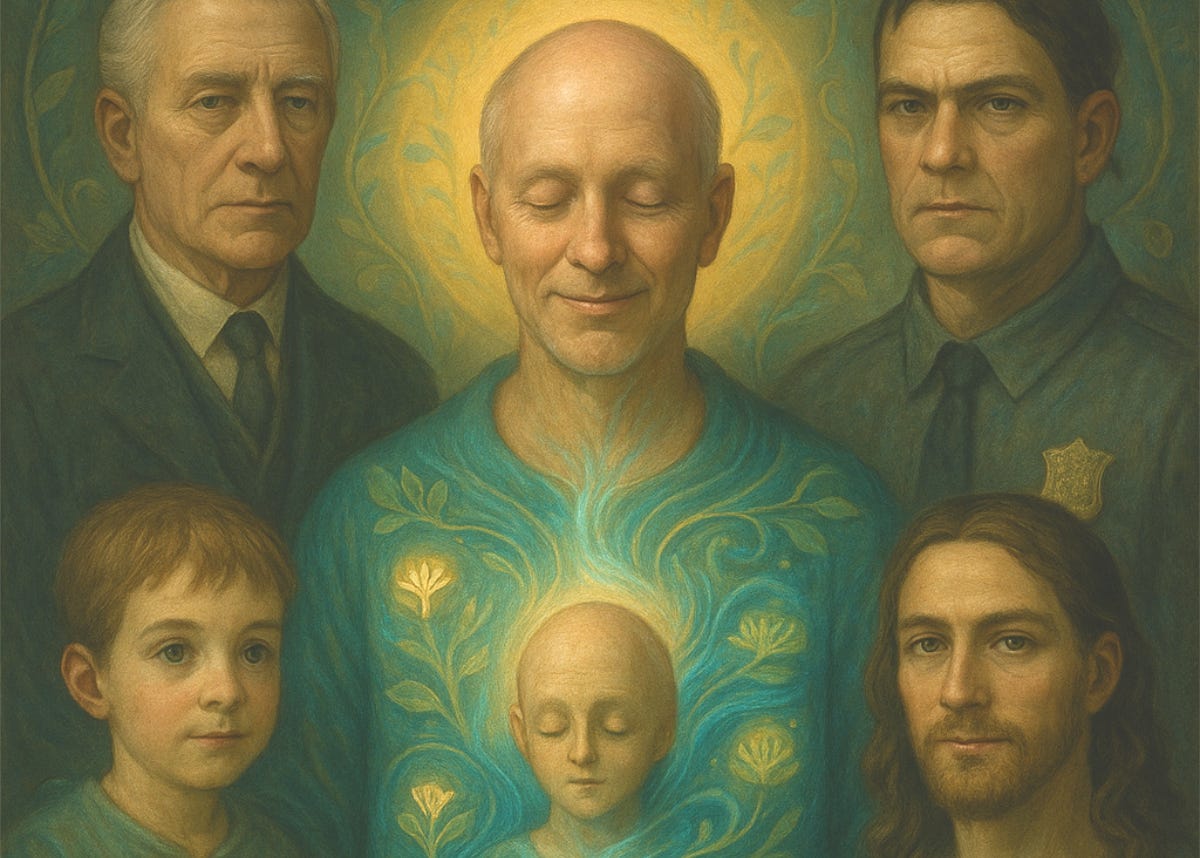
Are We Really Made of Parts?
In the 1980s Dr. Richard C. Schwartz began developing the Internal Family Systems (IFS) model and it has become the most popular “parts” therapy today. In his early work with patients who had eating disorders he heard them say things like, “a part of me believes that the thinner I am the more attractive I am,” or “when I overeat, a part of me says I’m weak and unlovable.” Dr. Schwartz took the “a part of me” part seriously. Maybe it was just a part of the person that thought or felt that way, and he became curious about that part — why did it think that way, and why was it so influential in the person’s life?
In 2000, he formed the Center for Self-Leadership, later renamed the IFS Institute, to promote the model in clinical, counseling, and coaching practices. Since then the model has become the most prominent alternatives to behavioral and cognitive treatments that dominate the space due to their effectiveness.
The fundamental idea of parts was proposed as far back as the influential book, Man and His Symbols, Edited by Carl Jung in 1964. In part 1 of the book Jung wrote about dreams, “It is on such [dream] evidence that psychologists assume the existence of an unconscious psyche — though many scientist and philosophers deny it’s existence. They argue naively that such an assumption implies the existence of two “subjects,” or (to put it in a common phrase) two personalities within the same individual. But this is exactly what it does imply — quite correctly.” He goes on to say that this state of division within the individual is not pathological, but quite normal and the result of the development of consciousness.
Dr Michael Sebastian in his paper, “Exploring Psychological Multiplicity in Jungian Psychology, IFS, and Schema Therapy,” points out that “William James, in The Principles of Psychology (1890), described the self as inherently divided, noting that individuals often experience conflicting desires and voices within their inner worlds. This fragmentation, he argued, was not necessarily pathological but a natural aspect of human psychology.”
Many remember cartoons from the 1960s depicting an angel and demon figure perched on a person’s shoulders trying to convince the person to follow his desire, or follow his principles or values. I suspect this experience of division within ourselves goes back further than these references, we find suggestions of it in scriptures and literary works thousands of years old.
Schwartz’ unique contribution was to bring Morton Mendel’s Family Systems Theory to this inner community. Schwartz identified a dynamic between the parts and a way to better integrate the “committee” that is us. The technique involves respectful dialogue with each part and building trust in what has come to be recognized as Self with a capital S.
Kenneth Gergen, in The Saturated Self (1991), argued that our ability to have different parts allowed individuals to let “different selves” emerge depending on the context and situation. Indeed protector parts can get very good at protecting us, and nurturing parts can get very good at parenting, and so on.
Parker J. Palmer in his book, “A Hidden Wholeness,” discussed the fact that we have this divided self, noting that we recognize it most when there is a separation between our inner truth and outer role. He calls this the “gap between our onstage performance and backstage reality.” Jung identified this reality as a distinction between our personas and our inner self. And when he said self, he envisioned something like an inner solar system where various parts orbited a central identity that later writers have called the true self or, you guessed it, simply Self with a capital S.
Self with a Capital S
In Chapter 3 of A Hidden Wholeness, Palmer explores the idea of the true self, saying, “We arrive in this world undivided, integral, whole. But sooner or later, we erect a wall between our inner and outer lives, trying to protect what is within us or to deceive the people around us. Only when the pain of our dividedness becomes more that we can bear do most of us embark on an inner journey towards living, “divided no more.””
Palmer used the idea of the Mobius strip to reveal that the two “sides” of the strip continue to co-create each other as we move around the strip. There is a wholeness, even as there are two sides. This is a nice way to understand how we can be “us,” or “who we are” as an individual. We (plural) as one (unity).
Thomas Merton, in New Seeds of Contemplation, describes when God discovers the divine identity in us, “At that moment the point of our contact with [God] opens out and we pass through the center of our own nothingness and enter into the infinite reality, where we awaken as our true self.” This is a realization that God sees God’s essence in all things, but also personification can be understood as a natural product of consciousness, both God’s and ours. In this sense, our self is selves all the way down.
A Critical Mass of Self
In an article on the IFS institute website[6] Dr. Schwartz describes his discovery of a calm compassionate Self behind the parts of several of his clients. He writes, “When they were in that calm, compassionate state, I’d ask these clients what voice or part was present. They each gave a variation of the following reply: “that’s not a part like those other voices are. That’s more of who I really am. That’s my Self.” He goes on to describe working with another client and how his own inner parts raised fears and concerns until there was a breakthrough in which the client’s own compassionate self was revealed. It is a deeply warming and encouraging account of Dr. Schwartz’ persistence and how his own centering in “Self” with a capital S creates a therapeutic trust. Dr. Schwartz writes that over the years he has, “come to trust the healing power of what I’ll call the Self in clients and in myself. When there’s a critical mass of Self in a therapy office, healing just happens.”
In an interview with Tami Simmon for Sounds True, Dr. Schwartz explained, “… that’s the way I’ve come to see Self, that it isn’t individualized; it’s not this little particle inside of us; but that actually, it is a field or a wave; and that when you enter that (and mystics have entered that for years; people can enter that these days through psychedelics often or meditating) you lose the boundaries around your individual body actually a lot of the time, and enter that field, you do feel this enormous connectedness and sense that we aren’t really different, we aren’t disconnected in the way we have been. And that then if you can bring that awareness, that C word, connectedness, back into your individual, body-bound Self (which is a lot of the impact I think of psychedelics now) it really changes many things in people’s lives, just that knowledge that we’re not these isolated little units.”
In the original article mentioned above, Dr. Schwartz says it another way, “Though they used different words, all the esoteric traditions within the major religions – Buddhism, Hinduism, Christianity, Judaism, Islam – emphasized their same core belief: we are sparks of the eternal flame, manifestations of the absolute ground of being. It turns out that the divine within – what the Christians call the soul or Christ Consciousness, Buddhists call Buddha Nature, the Hindus Atman, the Taoists Tao, the Sufis the Beloved, the Quakers the Inner Light – often doesn’t take years of meditative practice to access because it exists in all of us, just below the surface of our extreme parts. Once they agree to separate from us, we suddenly have access to who we really are.”
Dr. Schwartz says we can tap into Self at the very core of our being to provide a “deep keel for our sailboat in the storm,” This core, when we are grounded in it, keeps us centered in what he calls “… the deep ground of our being…” a term popularized by Paul Tillich.
Is Schwartz saying that the self at the core of our being, the Self with a capital S, is God? Perhaps not as some theists might conceive it, but I think he is suggesting something along those lines. For Schwartz (and perhaps Jung, Merton, and Palmer too) the Self with a capital S is a field in which we all participate and that connects all of us. Less an individual being, and more a universal presence manifesting or embodying the 8 Cs of the theory.
If Dr. Schwartz is correct, and I think he is, the coach and therapist’s job begins with an intention to heal and stabilize their own inner system to allow Self to flow freely.
As a Coach I will:
make enough space in my life for this work, and allowing enough time to build an ecology of practice around the 5 P’s.
hold space for others to experience a greater flow of Self, and to experience the healing power of the 8 C’s.
References - the C’s and P’s
The 8 C’s and 5 P’s
The 8 C’s of IFS are the core qualities of the Self:
Calmness: Emotional regulation for a strong stable systems that feels safe and can not be easily disrupted with turmoil, noise, or agitation.
Curiosity: Fascination, interest, and attention to novel or wonderous objects, situations, or experiences from an inquisitive desire to know and understand.
Clarity: A sense of seeing and understanding things and situations accurately and without confusion, gaps, or blind spots. In the context of coaching, it is seeing your parts and their roles without being overwhelmed by emotions or a desire to look away.
Compassion: The deep feeling of sharing the suffering of another that inclines or motivates a person to give aid or support or show mercy. It is essential to foster towards our parts as part of the process of affirming the effort and cost to fulfill their role.
Confidence: The feeling of assurance or certainty, especially in an ability, such as the ability to lead the internal system.
Courage: The state or quality of mind that enables one to face danger with self-possession, confidence, and resolution. In this context it is the inner fortitude or strength to face combative, vulnerable, or resistant parts or difficult emotions.
Creativity: The ability to bring into being novel or original ideas, stories, and objects, including the creation of innovative solutions and responses, such as new jobs for parts to do and unique ways that parts can resolve internal conflicts.
Connectedness: being bound together, joined, or united and the way in which things make contact, form networks, and form part of a whole. In groups it is the sense of belonging through social interaction and sharing. Internally is is a sense of unity and harmony within your parts.
These qualities are not just concepts—they are somatic signals (body-based experiences) that indicate when you are accessing your true Self. When you embody the 8 C’s, you’re no longer reacting from protective parts but leading from your authentic core. The Self is considered un-damageable and already present, even when obscured by trauma or stress.
The 5 P’s
Dr. Schwartz also frequently references the 5 P’s of IFS that he says embody the qualities of the Self:
Presence: Being fully aware and grounded in the present moment, observing internal experiences without judgment or the urge to fix.
Patience: Allowing each part of the system time to express itself, recognizing that healing unfolds gradually and requires space.
Persistence: Committing to the work even when it becomes difficult, consistently returning to the process with gentle, compassionate engagement.
Perspective: Stepping back to see the bigger picture, understanding parts’ roles and intentions within the whole system without getting caught in their immediate reactions.
and,
Playfulness: Approaching the inner world with lightness, curiosity, and creativity, which helps reduce resistance and encourages openness.